
Sleep Apnea Without CPAP: A Clear Look at Office-Based Treatment Options
You bought the machine. You tried the masks, the full-face version, the nasal pillow, the one your partner joked made you look like a fighter pilot. You gave it weeks, maybe months. And eventually, the CPAP ended up on the shelf, or under the bed, or in the back of a closet. You still wake up exhausted. Your bed partner still notices the pauses in your breathing. And you still have sleep apnea.
If this sounds familiar, you are far from alone. Research consistently shows that a significant portion of CPAP users discontinue use within the first year, and many more use the device far less than the recommended minimum. The good news is that the conversation around sleep apnea treatment without CPAP has matured considerably in the past decade. Minimally invasive, office-based options now exist that were not widely available even five years ago. This article is written for the patient who is past the diagnosis stage, frustrated with CPAP, and ready to have a more specific conversation with a specialist about what actually comes next.
Why CPAP Fails: It Is Not a Willpower Problem
Before exploring alternatives, it helps to understand why CPAP struggles to retain patients, because the reasons are largely structural, not personal.
Continuous positive airway pressure works by delivering pressurized air through a mask to keep the upper airway from collapsing during sleep. When it is used correctly and consistently, it is effective. The problem is the “consistently” part.
Common reasons patients abandon CPAP include:
Mask discomfort and fit issues. The seal required for effective pressure delivery makes mask fit critical and, for many people, uncomfortable across a full night of sleep. Movement during sleep, facial anatomy, and skin sensitivity all compound the problem.
Aerophagia. Swallowing pressurized air causes bloating, gas, and discomfort, which disrupts sleep in a different way entirely.
Claustrophobia and anxiety. The sensation of forced air, particularly for patients who are light sleepers or prone to anxiety, can make the mask feel suffocating rather than therapeutic.
Pressure intolerance. Auto-adjusting machines help, but some patients simply cannot acclimate to the pressure levels their apnea severity requires.
Noise and relationship disruption. Even quieter modern machines create enough ambient noise to disrupt a partner’s sleep, which adds social friction to an already frustrating situation.
None of these are character flaws. They are physiological and psychological realities that make CPAP a genuine mismatch for a meaningful subset of patients. Recognizing this is the starting point for exploring what else is possible.
The Anatomy of Your Airway Matters More Than You Think
Not all sleep apnea is the same, and one of the most important things a specialist evaluation does is determine where in the airway the obstruction is occurring. This distinction drives everything that follows.
Obstructive sleep apnea (OSA), the most common form, occurs when soft tissue in the upper airway collapses and blocks airflow during sleep. But “upper airway” covers a lot of territory. The collapse can occur at the level of the nose, the soft palate, the base of the tongue, the epiglottis, or some combination of these. Different sites of obstruction respond to different treatments.
A thorough specialist evaluation, which we will cover in more detail shortly, uses tools like drug-induced sleep endoscopy (DISE) to visualize exactly where the airway is collapsing. This is not guesswork. It is direct visualization, performed while the patient is in a light, medically induced sleep, so the specialist can see the airway behaving as it does during natural sleep. That information is what makes targeted, office-based treatment possible.
Patients traveling from outside the Los Angeles area, including those making the trip from Las Vegas or elsewhere in Nevada, often mention that this level of diagnostic specificity is what prompted them to seek a specialist at a dedicated center rather than continuing with a general sleep medicine approach.
Office-Based Treatment Options Worth Knowing About
This section does not promise outcomes. What it does is describe the categories of treatment that a specialist in Beverly Hills, CA may discuss with you based on your anatomy, apnea severity, and history. The right path depends on your individual evaluation.
Oral Appliance Therapy
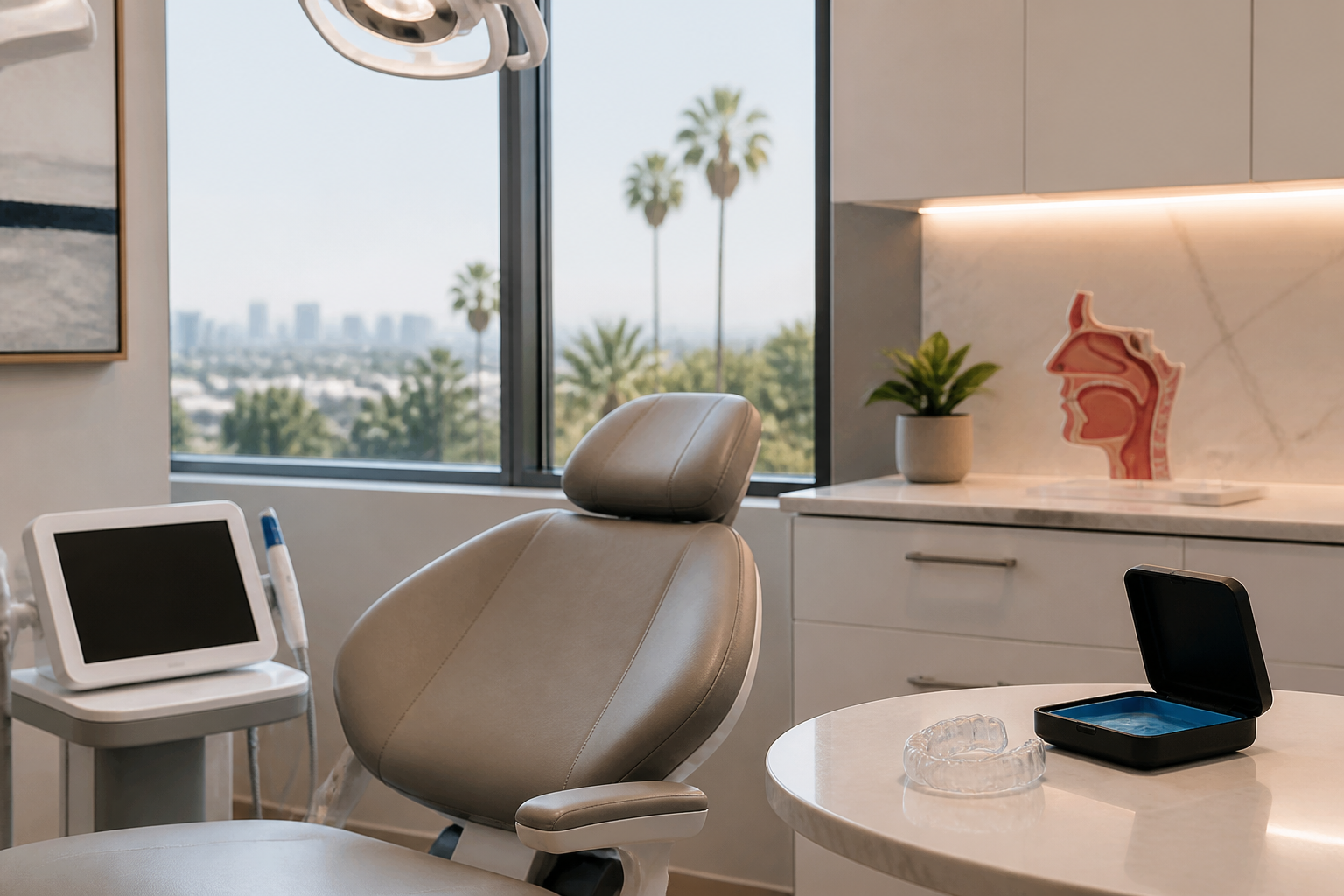
Custom mandibular advancement devices (MADs) reposition the lower jaw slightly forward during sleep, which tensions the soft tissue of the throat and reduces the likelihood of collapse. They are fitted by a dentist with sleep medicine training and adjusted over several appointments. Oral appliances are generally considered appropriate for mild to moderate OSA and for some patients with more severe apnea who cannot tolerate CPAP.
They are not a universal solution. Patients with significant temporomandibular joint issues, extensive dental work, or certain bite patterns may not be good candidates. A specialist evaluation will include an assessment of whether oral appliance therapy is anatomically suitable for you.
Soft Palate Procedures
Several minimally invasive procedures address obstruction at the level of the soft palate. These include radiofrequency ablation, which uses controlled energy to stiffen palate tissue and reduce its tendency to collapse, and palate implants, which serve a similar stiffening function.
These procedures are typically performed in-office under local anesthesia. Recovery is generally manageable, with some temporary throat discomfort. They are most appropriate when palate-level collapse is confirmed as a primary obstruction site, which is why pre-procedural imaging or endoscopy matters.
Nasal Procedures
The nose is the front door of the airway, and nasal obstruction, whether from a deviated septum, enlarged turbinates, nasal polyps, or chronic inflammation, can significantly worsen sleep-disordered breathing. In some patients, nasal obstruction is a primary contributor. In others, correcting it improves CPAP tolerance enough that the machine becomes usable, or it reduces apnea severity enough to make downstream treatments more effective.
A center like LA Sinus and Snoring, where sinus care and sleep-disordered breathing are treated under the same roof in Beverly Hills, CA, is well-positioned to evaluate and address nasal contributions to airway obstruction alongside the apnea itself.
Positional Therapy
For a subset of patients, OSA occurs primarily or exclusively when sleeping on the back (supine position). Positional therapy devices discourage supine sleep through vibration or positional coaching. On its own, this approach is limited in scope, but for the right patient, it can be meaningful, and it is worth raising during a specialist consultation to understand whether position is a significant variable in your specific case.
What an In-Office Evaluation Actually Looks Like
If you are in research mode and considering a consultation, knowing what to expect makes the process less opaque.
An initial evaluation at a specialist practice in Beverly Hills typically involves a detailed medical history, a review of your prior sleep study results and CPAP compliance data if available, and a physical examination of the nose, mouth, throat, and neck. The specialist is looking for structural contributors to obstruction: septal deviation, turbinate hypertrophy, tonsil size, soft palate anatomy, tongue position, and jaw structure.
Depending on what that examination reveals, the specialist may recommend additional in-office assessment. Drug-induced sleep endoscopy, mentioned earlier, provides a dynamic view of the airway during simulated sleep and is considered a valuable tool in surgical and procedural planning. Some patients also benefit from updated or more detailed sleep testing, particularly if their original study was a home sleep test with limited data.
The conversation you should expect to have in that consultation includes: where is the obstruction occurring, what options are appropriate given your anatomy and severity, what the procedural process involves for each option, and what the realistic range of outcomes looks like. A specialist who does not walk you through all four of those areas has not completed the conversation.
For patients traveling from Las Vegas or other parts of the Southwest to consult with a specialist in Los Angeles, this initial evaluation is typically schedulable as a single visit, with follow-up care coordinated around your availability. Many out-of-area patients find it practical to plan a consultation day and, if imaging or endoscopy is indicated, schedule that on the same trip.
Questions to Bring to Your Specialist Appointment
Going into a consultation prepared makes the time more productive. Consider bringing:
- Your most recent sleep study report, with AHI (apnea-hypopnea index) and oxygen saturation data
- A record of your CPAP compliance data if your machine tracks it, or an honest summary of how and when you used it
- A list of what specifically made CPAP difficult for you (mask type, pressure issues, discomfort)
- Any prior dental or nasal evaluations relevant to airway anatomy
- Notes on symptoms that affect your daily life, including morning headaches, daytime sleepiness, mood, and concentration
Specialists use this information to triage your case and prioritize the evaluation. The more specific you can be, the more directed the conversation can be.
Taking the Next Step
Untreated sleep apnea carries real consequences, including effects on cardiovascular health, cognitive function, and overall quality of life. CPAP failure does not have to mean treatment failure. The range of office-based and minimally invasive options available today is meaningfully broader than it was even a few years ago, and the right starting point is a thorough evaluation with a specialist who treats the airway as a system rather than a single variable.
LA Sinus and Snoring serves patients from Beverly Hills, CA, across the greater Los Angeles area, and from out of state including patients making the trip from Las Vegas specifically to access specialist-level care. If you have a diagnosis and a CPAP you stopped using, that is exactly where this conversation starts.
Contact LA Sinus and Snoring today to schedule a consultation and find out which treatment path fits your anatomy, your severity, and your life.